

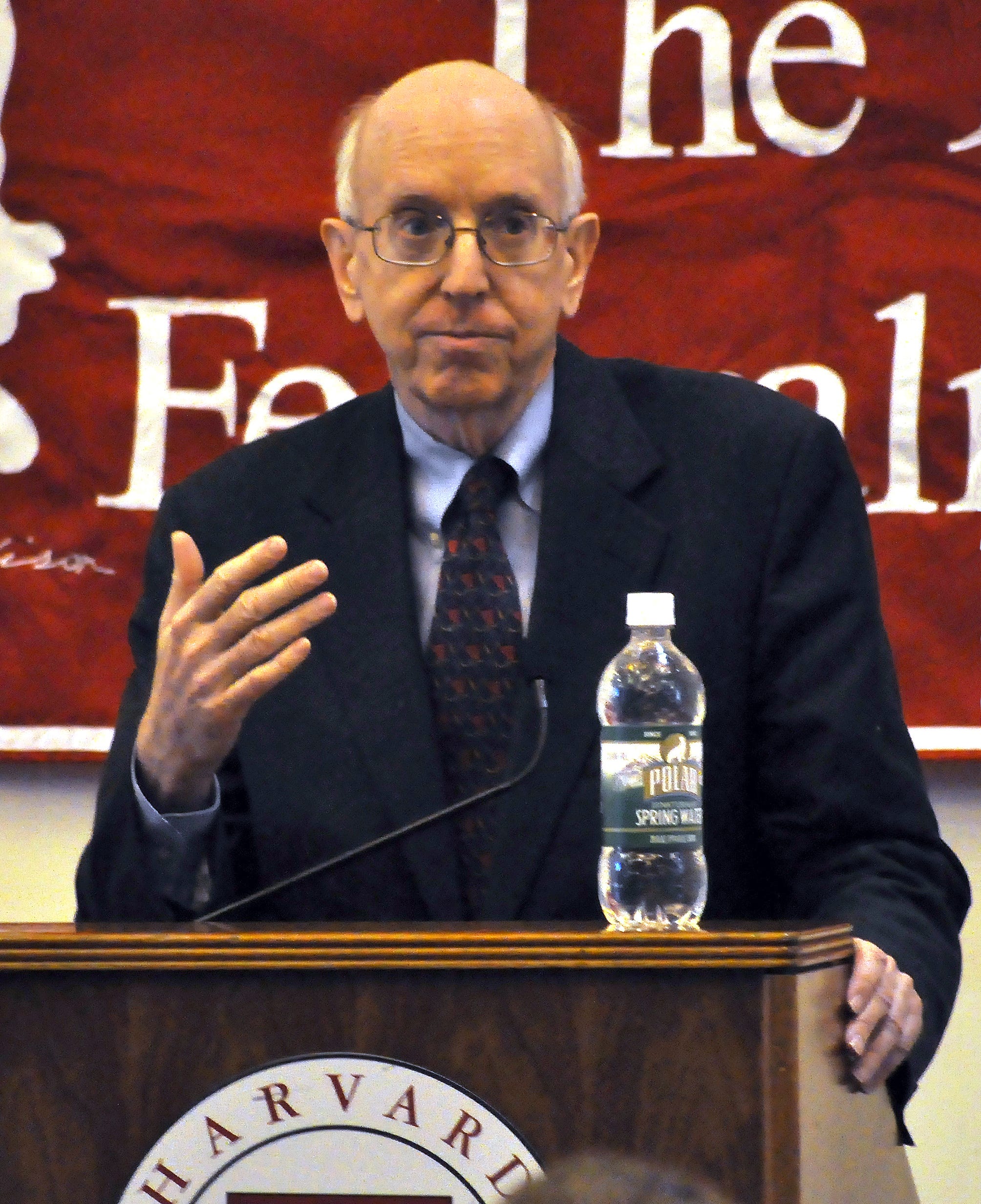
On November 10, the legal scholar Richard Posner died at the age of 87.
I’m not writing an obituary of Posner; that has already been done many times over. Rather, I’d like to explain to a new generation why Posner deserves all the praise that he’s gotten, with a focus on the parts of his story that should matter especially to the young and ambitious.
Posner took one great idea he learned from then-future Nobel laureate Ronald Coase and used it to entirely change how judges make law and how professors teach law. Most of Posner’s greatness came from imperiously evangelizing this idea—the Coase Theorem, which Coase set out in a 1960 article in the Journal of Law and Economics entitled “The Problem of Social Cost”—so most of this article will be about the idea with which Posner transformed the American judiciary.
To understand the world-historical importance of the Apostle Paul, one must first understand the message of Jesus. And to understand the world-historical importance of Judge Posner (U.S. Court of Appeals for the Seventh Circuit, 1981 to 2017), one must first understand Ronald Coase, who wrote his great work not at the University of Chicago, with which he’s usually associated, but at the University of Virginia. While at UVA, Coase worked at the Thomas Jefferson Center—the predecessor to George Mason University’s Center for the Study of Public Choice, where I myself hold a position. We GMU economists thus are in a good position to evaluate Posner—to ask whether he remained true to the simple, pure Coasean gospel. And indeed he did, far more than most economists did.
The basic version of the Coase theorem, which you’ve probably heard of, goes like this:
Suppose one person creates a hassle—legally, a nuisance—for another person, by, say, making a lot of noise in the middle of the night. The Coase theorem tells us that in a lot of settings, if people are allowed to reach legally binding agreements with each other, then people will bargain to the same efficient solution to the nuisance regardless of which party has the stronger legal right.
Suppose the law says everyone has the right to silence. Then, if the noisemaker really loves noise more than the other party loves silence, the noisemaker can pay the other party for the right to make noise. On the other hand, if the law says everyone has a right to make noise (a common rule during the daytime in many places), the silence-lover can try to pay the noisemaker for some peace and quiet.
Immediately you’ll ask: Hey, what if one side is vastly richer than the other? That actually reinforces Coase’s original point. Suppose the noisemaker is the rich one. Then if he starts off owning the right to make noise, there’s no way Mr. Silence will be able to afford to pay for the silence he loves. And if Mr. Silence starts with the legal right to silence, Mr. Noise will obviously just pay Mr. Silence a ton of cash for the right to make noise. We come to the same result—noise—regardless of who starts off with the right to control the amount of noise. The key difference between the scenarios is that if Mr. Silence starts off with the right to silence, then he ends up with a ton of cash; but either way, he’s going to end up with a ton of noise.
Coase thus taught us the power of the side deal, the deal that comes after the government hands out official property rights. A lot of criminal law and a lot of government regulation is about creating bans on such side deals: it’s always illegal to dump radioactive waste, it’s always illegal to drive (or build!) a car without a seatbelt. In tort law, the realm of lawsuits, by contrast, side deals are the stuff of life—sometimes explicitly, sometimes in the form of out-of-court settlements (and the accompanying NDAs). Tort law and its open scope for side-deals are a good analogy for a lot of modern social interactions, from log-rolling in a legislature to bargaining about chores among roommates. The Coase theorem is a big deal, and—at least as economists usually tell it—it started as a story about simple tort law. As I wrote in my book Hive Mind: How Your Nation’s IQ Matters So Much More Than Your Own, Ronald Coase taught us “The Astonishing Power of Haggling.” When governments dole out property rights, what they’re really doling out, in Coase’s view, is a starting point for future negotiations.
If you take a couple of undergrad economics courses, you’ll learn the Coase theorem along the way. It shows you what’s possible when people are allowed to haggle and when they can make deals that stick. And yes, Posner considered the Coase theorem a starting point for his radical reinterpretation of the law. But he did more than that. Posner did something that well-educated economists, even professors doing research in the area, almost never do: he actually read Coase’s article.
When you read Coase’s article, what you learn is that Coase thought that judges already were often implicitly following the Coase theorem to decide nuisance cases, and that the British common law already had a lot of the Coase theorem built into it. Coase was making the implicit explicit, revealing hidden structure in the law.
Judges care about “proportionality,” they care about “reasonableness.” And “reasonableness,” in a judge’s mind, means something like “passes a cost-benefit test.” Courts are handed legal problems—especially in tort law—with a goal of solving them, not a goal of kicking off the next round of side deals.
So judges like to come up with solutions that work, that last; indeed they like to come up with solutions that other judges will cite, will draw upon, and will recycle. Citation is one of the currencies of the realm in the world of law. And one way for a decision to work—as Posner emphasized in his Coasean evangelization—is to come up with a solution that maximizes overall wealth. One way to do that is to create incentives for cheap fixes to social problems, to hand out cash penalties to those destroying wealth, and to write those decisions so they get, again and again, recycled. So in practice, reasonableness looks like what Coase often saw happening in British courts: judges trying to come up with solutions that will stick because they combine perceived fairness (whatever that is) with wealth-maximizing decrees (something we can at least hope to measure).
So the “Coase theorem” is about the potential for good ex-post negotiation, but Coase’s actual article was more about the actual practice of British common law, which he thought had a powerful (not total!) tendency toward efficient decisions. Posner, reading that for the first time, must have had a Damascus-level insight. He had come upon a skeleton key for understanding and, with time, rewriting the common law: he would make the common law more Coasean. And for decades, that’s exactly what he did. He tried to come up with efficient solutions again and again and again. He said, in a 2006 debate at the Center for Law and Security, that his goal was to find a “sensible” solution first, “the result that would be best for the country,” and then see if he could come up with a legal argument for that solution. That wasn’t how judges normally did their job. In Posner’s words: “My approach is actually heretical.” Posner followed his heretical approach in:
Nuisance law: He worries less about who was hurt by a nuisance and more about what would be the social cost of any solution he imposed. He favored the least-cost solution.
Negligence: He made the 1947 Learned Hand formula (yes, that’s the name of a real judge) even more famous:
B < P x L
If the burden of safety precautions is lower than the expected cost of a loss (Probability times Loss), then courts should penalize those who don’t take the precautions. On the other hand, if the burden of safety precautions is too high, then courts shouldn’t demand that parties take safety precautions. So even if we didn’t have government requirements for seatbelts, which aren’t that expensive, tort law might de facto require them via large cash judgments against car manufacturers. But tort law wouldn’t require a half-million dollars in safety equipment in each car, even if the equipment saved lots of lives: B > P x L means you’re on your own.
Contract law: Efficient breach. The meaning of the phrase is obvious: it’s OK to cheat when it’s a big deal, just require the cheater to pay for the right to cheat.
Civil procedure: Using the legal system is expensive, so discourage people from using it unless there’s a big social win at the end of the lawsuit rainbow.
Many Posner obituaries will tell you that as he got older he said efficiency wasn’t everything and that right and wrong matter too, but his equivocation isn’t what changed the legal world: it was his strong early vision backed by his profound, total embrace of Coase’s “Problem of Social Cost.”
The sociologist Kieran Healy wrote a 2017 paper entitled “Fuck Nuance.” First two sentences of his abstract:
Nuance is not a virtue of good sociological theory. Although often demanded and superficially attractive, nuance inhibits the abstraction on which good theory depends.
The same is true across the social sciences, and for intellectual innovators everywhere. Powerful insights depend on overarching—read “glib”—generalizations, and on being willing to leave the matter of sorting out the details to minor historical figures. Judge Posner was, in the influential framework of Isaiah Berlin, a determined intellectual hedgehog, knowing one big thing and building a powerful, imperialistic body of thought from that one big thing. Berlinian foxes—who instead know many things—have their place, and some become famous because they know many things, for providing context and detail and factoids; I confess I love doing that myself. But the greats of the life of the mind, both in purely theoretical and applied fields, are nearly uniformly hedgehogs, turning the same crank over and over, becoming a brand themselves, even becoming trapped by their own branding.
Perhaps Posner became a prophet merely by accident: perhaps he created modern law and economics, summed up by his incredibly readable Economic Analysis of Law (many editions) only because he said what he thought was true. And then when, later in life, he thought something else was also true—like the reality of market failure or the need for legal nuance or that capitalism had failed during the financial crisis—he, again, just said what he thought. Perhaps for Posner, the greatest form of intellectual consistency was not to have a fully comprehensive legal vision but instead to simply say what one believes at the moment one believes it.
We’ll leave that to the biographers, and he deserves more than one. But here, I would simply like to declare that his cultural and intellectual power, his historical importance, came from the grand vision he carried from economics to the entire global legal system. May Richard Posner rest in peace, and may his memory be a blessing.
I close with some quotes from the 8th edition of Economic Analysis of Law, to show the imperialistic mind at work, even in later years, when the nuance had crept in.
On how economics went from topic to toolkit:
“Traditionally, economics had been thought to be defined by its subject rather than by its method. Its subject was the economy; and the legal system, though understood to affect the economy, was not thought to be itself an economic system, in the sense of a site of activity that could profitably be studied in economic terms. (Climate affects the economy, but the climate is not an economic system.)… A deeper, wider, more sustained engagement of economics with law had to await recognition… that economics is a theory as well as an “area study”—specifically the theory of rational choice, a theory that can in principle be applied to any social activity (even nonhuman), thus including law, even when law regulates nonmarket activities, such as crime, adjudication, or marriage.”
On how English nuisance law tended toward efficiency—or how, in a well-functioning legal system, you didn’t need all the ex-post haggling that later economic theorists called the “Coase theorem”:
“Coase intimated that the English law of nuisance had an implicit economic logic. Later writers have generalized this insight and argued that many of the doctrines and institutions of the legal system are best understood and explained as efforts to promote the efficient allocation of resources—a major theme of this book.”
On the need to look for hidden meanings in legal decisions (written by one of the world’s great jurists!):
“[O]ften the true grounds of legal decision are concealed rather than illuminated by the characteristic rhetoric of opinions.”
Thus, “The judge said X” is not, to Posner, undeniable evidence that the judge believed X. Reading between the lines is important, especially on controversial topics.
Here he says what the common law mostly is (note that he’s not saying that’s what it should be, but then again maybe he’s concealing his true views):
“The theory is that the common law is best (not perfectly) explained as a system for maximizing the wealth of society.”
Some might say that legal judgments are designed to address past injustices; but what people, even judges themselves, say a thing is about may not be what it is about (again with the potential hidden meanings). As Posner says here, a judge’s decision is a warning to those in the future, which means it’s changing incentives for behavior in the future. Emphasis added by me:
“By thus altering the shadow price (of risky behavior) that confronts people, the warning may affect their behavior and therefore accident costs.”
Far from the most controversial Posner quote:
“We shall see that practitioners [of Chicago-style Law and Economics, which Posner did so much to create] have found that capital punishment deters, legislation designed to protect consumers frequently ends up hurting them, no-fault automobile insurance is inefficient, some discrimination is efficient, and much of securities regulation may be a waste of time.”
On how, within academia and the courts, only conservative views are coded as ideological:
“For example, the [economic] theory of public goods [spelled out by the mid-century Keynesian Paul Samuelson] could be viewed as one of the ideological underpinnings of the welfare state, but is not so viewed; once a viewpoint becomes dominant, it ceases to be perceived as having an ideological character.”
Richard Posner is a powerful, clear writer who does not waste your time; but stick to his law and economics work if your goal, like his, is efficiency. Posner is a worthy role model for those who want to use scholarly ideas to create institutional change.

As an aside, one crucial aspect of the Coase theorem that is underexplored (even by Posner) but that I find fascinating -- and unsettling -- is the idea of reciprocal harms. See, for example, my paper "Coase's fable": https://papers.ssrn.com/sol3/papers.cfm?abstract_id=7687364