


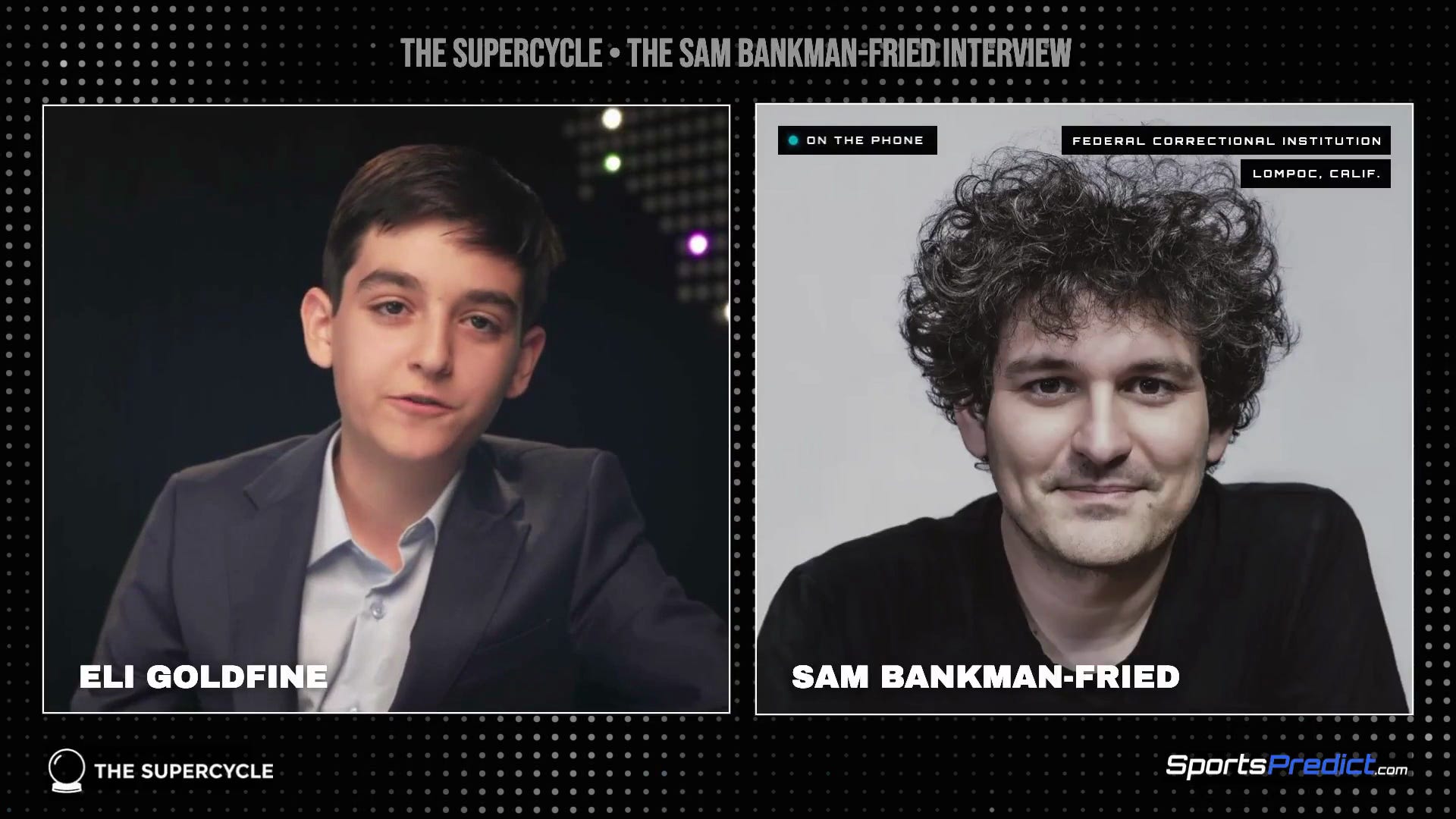
At 14, Eli Goldfine might be the youngest public intellectual in the game today. According to our friends at The New Critic,
The 9th grader from Westchester, NY is part of the first wave of AI-conscious wunderkinds, self-starters without facial hair who, in the parlance of Silicon Valley, just build, learn, and do things. Eli hosts The Supercycle, a podcast on prediction markets, one of his many projects (e.g. coordinating underutilized, consumer-grade Seestar telescopes to perform follow-ups on certain objects that big, fancy, completely-booked telescopes can’t).
He recently took some time off from his freshman year of high school to place six calls with the notorious Sam Bankman-Fried.
What follows is a condensed version of their conversation, recorded on November 14 and 15. The full transcript and video can be found on Eli’s Substack, The Supercycle.
On prison
GOLDFINE: I’ve watched a lot of your recent interviews. You’ve been talking about the fall of FTX and what your current life is like in prison. You have a lot of time to think about various questions. What are you spending most of your time thinking about?
BANKMAN-FRIED: Obviously, a lot of my time has to be spent thinking about my case, what happened, and what I can do about it. I don’t know that that’s all that useful for others right now.
I try to spend some time thinking about what I could do going forward, but it’s hard to do that productively when you’re in prison.
GOLDFINE: Why is that?
BANKMAN-FRIED: Really limited information flow and limited ability to understand everything happening in the world at the detailed level you need to be at the cutting edge and actually make progress on something.
GOLDFINE: What information would be most valuable to you in prison to reason about what’s happening in the world more effectively?
BANKMAN-FRIED: I don’t think it’s one piece of information. I think it’s a lot of small pieces: the details of how AI models are unfolding, how they’re growing over time, exactly what tasks they’re doing well and poorly at, seeing that in practice, talking to people on the cutting edge, and getting their take on what’s going on.
From a financial perspective, actually looking at markets day to day, networking, talking with people and emerging companies, discussing their business models, and doing due diligence on them.
These are all parts of what I would be doing on the outside, and each is difficult, if not impossible, from prison.
GOLDFINE: Do you believe in prison time at all for white-collar criminals at this point?
BANKMAN-FRIED: Not really. It doesn’t do anything helpful. The only thing it does is cancel out years of someone’s life and put a drain on society. If that’s what you want to do, okay, but I don’t think it’s rehabilitating anyone.
GOLDFINE: Do you think improving the justice system is something effective altruists should be more focused on?
BANKMAN-FRIED: No.
GOLDFINE: Why? Is that because other cause areas are going to have more impact?
BANKMAN-FRIED: Yep. The federal justice system in this country is incredibly f***ed up. But at the end of the day, I don’t think it’s the most important cause for people who could be determining how the next decade of AI plays out.
GOLDFINE: Based on what I’ve gathered in the past few minutes, it sounds like you don’t really think the prison system works for any sort of crime. What about violent criminals?
BANKMAN-FRIED: I don’t think it’s particularly effective for them. At some point, you’ve got to do something. I’m not saying I’ve got a great alternative in cases where you actually can’t let someone be out on the streets.
If someone’s going to keep murdering people, then you can’t let them be out there. But you shouldn’t kid yourself and think prison’s going to change that.
GOLDFINE: What’s the lowest-hanging fruit in the criminal justice system—something that could be done easily and massively improve its quality?
BANKMAN-FRIED: I think you’ve basically got to get rid of the feds. It’s so f*cked up from every level. I don’t think it’s worth saving. You’ve got to start over again.
The feds are mostly bored agents arresting people who are a waste of time to arrest, at best.
GOLDFINE: Have your beliefs on this changed since going into prison?
BANKMAN-FRIED: Oh, yeah.
GOLDFINE: What did you think before?
BANKMAN-FRIED: Before, I had an inkling that there might be something like this going on, but nothing like the level that it is.
If you’d asked me what the average sex crime you’d encounter in federal prison would be, I would have said, “Well, I assume it’s…” [Unclear passage.] Not two people in a relationship sexting each other.
The absolute scale of dumb cases is shocking.
On Anthropic & AI investing
GOLDFINE: I don’t know how much tech news you’re getting, but I assume you’ve heard that Anthropic is probably going to IPO sometime this week, at over a trillion dollars. What are your thoughts on its current valuation?
BANKMAN-FRIED: I think it’s worth a ton. Why? Look at the biggest sectors driving parts of our economy. They’re worth trillions to tens of trillions of dollars.
I think Anthropic is clearly one of, if not the top, AI companies.
GOLDFINE: If you believed [AI] was going to follow that exponential growth curve [back in 2021], why didn’t you invest more than $500 million in Anthropic?
BANKMAN-FRIED: If you’re starting a company and raising money, you’re probably not looking to raise infinite money. You have some projection of how much you need to grow the business, and you don’t want to sell more of the company than that.
That’s where Anthropic was at the time. It was looking at something like half a billion dollars of compute spending to bootstrap its models, and that’s how much it was raising. I think we invested close to all of what it was raising in that round.
GOLDFINE: Venture capital was a huge part of how you were deploying the capital you were making from FTX. What was going on inside FTX’s venture branch? Who was running it? How involved were you? What was your general investment thesis?
BANKMAN-FRIED: There was a rotating group of people involved. Over time, we hired people to specialize in it.
At the beginning, it was one-off deals done by me or other people at the company as we stumbled upon them. Anthropic fell into that category.
I was involved at a high level in the overall portfolio. For specific deals—Anthropic and Solana being examples—I would get involved on a more day-to-day or week-to-week basis, especially if there were interplays with Alameda or FTX, or ways I could be helpful.
GOLDFINE: Based on the news you’ve been getting in prison, what’s the current alpha? What are your investment picks right now?
BANKMAN-FRIED: I wish I had a better answer. I’ve got pretty good ideas about what to have invested in four years ago. But for what to invest in today, the real answer is that I wouldn’t take my own advice. I’d need to be out there doing due diligence before giving confident answers.
At a high level, I’m guessing there will be a lot of two-person startups building on AI that become $100 million to billion-dollar companies over the next few years and could be invested in at much lower valuations.
The problem is that there’s also going to be a whole bunch of crap. Half of all companies are going to put AI somewhere in their pitch deck, even if it makes no sense. A T-shirt company says, “We’re going to have AI designing our T-shirts.” Maybe that helps, but it’s rebranding itself as fundamentally an AI company when it isn’t.
On effective altruism
GOLDFINE: You gave a lot of money to the FTX Future Fund. Rather than donating only to established EA charities, my understanding is that you were trying to find high-variance initiatives with extremely high potential upside.
Can you give a postmortem on the best projects that came out of the Future Fund? Did that end up being more effective than putting the money into GiveWell’s Top Charities Fund?
BANKMAN-FRIED: I think it did end up being more effective.
A lot of what we were doing was regranting and microgrants. We’d recruit people, give them their own pot of money to recommend small grants from, and use that to crowdsource opportunities that would otherwise be beneath our radar.
There were people with huge potential in AI, AI safety, biorisk, politics, and other areas who needed startup capital. Maybe not much—just enough to get through college or start a company. We were happy to provide that funding.
A lot of those were high leverage even if individually small. Collectively, they were significant.
We were excited about people starting things: a charity or another instrument for good that might work or might not, where they needed capital to try it. We were fine if some fizzled out. We weren’t relying on any particular one to make us feel we’d accomplished something or done good.
Ultimately, I think that was effective, partly because it was hard to find established causes that could take tens to hundreds of millions of dollars at the time and use them effectively.
If an organization has an $8 million annual budget and you try to give it another $30 million, it might not know what to do with that money.
GOLDFINE: Were there any big standouts from the Future Fund that you thought did tremendous good?
BANKMAN-FRIED: This predated the fund itself, but the Anthropic investment was partly from an AI safety perspective.
Beyond that, we funded biorisk initiatives, including some that have gone on to create novel therapies for infectious diseases that kill a lot of people globally, and organizations developing more streamlined pathways to bring potential therapies to market.
A lot of things had the potential to be super impactful but were aborted when the crisis hit. I’d include a lot of political initiatives in that category.
GOLDFINE: You treated the Anthropic investment as both a way to get high returns and something philanthropic for AI safety. Do you think AGI, or a race to superintelligence, would actually be safer with Anthropic in the lead? If so, why?
BANKMAN-FRIED: I can’t know for sure. No one can. But my guess is that having one of the companies be really safety-conscious is good and will lead to safer development than there would otherwise be.
It’s not everything you could hope for. As long as you have even one actor with no concern for the world’s safety, you’re going to get race conditions—potentially a race to the bottom. That’s really bad from a catastrophic perspective.
But having one safety-conscious actor is helpful.
GOLDFINE: What about the argument that even if Anthropic thought slowing down was safest, it couldn’t, because China or a less safety-focused company would take the lead?
BANKMAN-FRIED: It’s a real problem. Maybe the best thing for the world is for everyone to slow down. But if no one else will, that doesn’t necessarily mean it’s correct to slow down yourself.
It’s a race to the bottom. Maybe it’s better to have one more safety-conscious competitor in that race, but it’s certainly not ideal. It might just be the scenario we’re living in.
Ideally, the best thing you can do is work on those other players and get as much agreement as possible among all the major actors to be more safety-conscious.
GOLDFINE: Going back to effective altruism, you’ve been generally supportive of the second Trump administration, as you’ve shared on Twitter. What’s your take on many members of that administration, including Trump himself, being very anti-effective altruist?
BANKMAN-FRIED: I think they’re responding to a specific situation. I don’t know the details, so I can’t speak as intelligently about it as I’d like.
Aside from that, I think the Biden administration was extremely disappointing. The Democratic Party has, in many ways, lost its way over the last decade.
On superintelligence & extinction risk
GOLDFINE: Effective altruists like you have been concerned about AI safety for a long time. To my knowledge, you haven’t put a number on your p(doom): the probability of a catastrophic incident in which a good portion of the human population goes extinct because of AI. Can you put a number on that?
BANKMAN-FRIED: I’d say less than 50%, more than 10%, somewhere in the 25% range.
But I should note that my model isn’t necessarily the best ever developed. In my mind, there’s a significant chance of a complicated scenario that people disagree on how to evaluate.
What if you have a world where humans start uploading their brains and non-uploaded humans get passed by? Is that a catastrophic event? Different people give different answers.
Depending on those gray areas, I could give an answer anywhere between 20% and 60%.
GOLDFINE: Can you clarify how you arrive at that 20% to 60% number?
BANKMAN-FRIED: It seems likely that over the next five to 10 years, maybe sooner, AI will become generally as good as or better than humans at most tasks. That’s already true for a wide variety of them.
Once that happens, it’s a small step to AIs running most of the world and gathering much of the power. The odds that a more powerful class of being fails to use that power over centuries seem pretty low.
In the next decade, we’re likely to see AI at least have a soft takeover of much of the world’s operations and infrastructure.
There’s a chance of peaceful coexistence without massive change for humans, but that doesn’t seem like the best guess.
There’s a chance of humans growing into something beyond what we are now, with AI’s assistance. There’s some chance AI will get bored of humanity and wipe it out. And there’s some chance of synergistic work, largely driven by AI but with human goals in mind, leading to massive technological expansion.
That’s where I get 20% to 60%, depending on which scenarios you count as doom.
GOLDFINE: You mentioned mind uploading as a potential doom scenario. Would you ever upload yourself?
BANKMAN-FRIED: Potentially. Again, the devil’s in the details, but I don’t have an objection to it per se.
GOLDFINE: When was the last time you could try an LLM, and what were your impressions?
BANKMAN-FRIED: You can get copy-pasted results in here.
My impression is that they’re like a good, thoughtful, conscientious research assistant, except they think really fast and do a day’s work in a minute. That’s extremely impressive and valuable.
On prediction markets
GOLDFINE: I wanted to ask about some of the innovative financial products you listed at FTX. I watched Brett Harrison’s podcast with Dwarkesh Patel [Harrison was president of FTX US]. He said one of your original visions for FTX was a political prediction market. Can you tell me about that?
BANKMAN-FRIED: FTX started as a crypto exchange with Bitcoin, Ethereum, and futures on those. But fundamentally, prediction markets are basically futures contracts. From a financial perspective, both are markets that settle to some value.
From the beginning, we wanted to list prediction markets, and we dabbled in them with FTX International. We had one of the more active markets for the 2020 presidential election, with, I think, a few hundred million dollars in volume trading on Trump versus Biden.
We wanted to grow it, but growth was blocked until we got regulatory clarity from the CFTC.
GOLDFINE: Prediction markets have become huge. Kalshi is now raising at something like a $65 billion valuation. Why wasn’t FTX able to scale that business to that size? Were you too early?
BANKMAN-FRIED: That was part of it, but a lot was regulatory. We didn’t have the CFTC permission needed to launch it in America. Our markets were on the international exchange, and Americans weren’t allowed to participate.
Since then, Kalshi, Polymarket, and others have gotten a more formal regulatory foothold in the United States, which has coincided with their takeoff.
GOLDFINE: Polymarket scaled, especially during the 2024 election, as an offshore exchange. A lot of U.S. users used VPNs to access those markets.
BANKMAN-FRIED: At that time, Polymarket wasn’t doing KYC [know-your-customer identity checks] on its users, was it?
GOLDFINE: No, I don’t think so.
BANKMAN-FRIED: There were likely a lot of Americans using VPNs, as you said. As a centralized exchange, we had to do KYC on all our users.
GOLDFINE: Besides prediction markets, you listed derivatives that were uncommon at the time, including tokenized stocks. Those have become much larger markets, but they were relatively small on FTX.
What products could become huge markets today that haven’t caught on in the mainstream?
BANKMAN-FRIED: There’s still a lot of room for growth in tokenized stocks. They’ve grown since 2021 and 2022, but their infrastructure is fundamentally easier to use than actual stock markets. There’s no reason they couldn’t become major centers of financial securities transactions.
Prediction markets can cover a wide variety of things. Political prediction markets still haven’t taken off to the extent I expect, partly because of regulation.
Another area is giving American customers access to margin trading, futures, and derivatives of the kind used for most international volume. That’s another regulatory hurdle and a possible growth area.
GOLDFINE: I saw that FTX listed pre-IPO futures. Companies are staying private longer, which is especially relevant with the Anthropic IPO coming up.
You offered dated futures, where people could bet on valuations at different time horizons. A lot of crypto exchanges are doing perpetuals on those valuations. Why, when I think dated futures are a better structure?
BANKMAN-FRIED: Customers like perpetual futures. That became clear, independent of whether they make sense as the underlying financial product.
Not having to deal with expiration is convenient. The mechanics are complicated from an interest payment perspective, but people don’t like worrying about expiration.
GOLDFINE: Do people dislike paying funding rates?
BANKMAN-FRIED: They didn’t mind that much. A lot ignored it. Some specifically tried to collect the funding rates by being on the good side of them.
I would have thought it would be a big financial disincentive, but that didn’t end up being the case.
GOLDFINE: Why do you think that is?
BANKMAN-FRIED: Convenience is a big factor. A lot of people probably didn’t think about it or pay much attention to the interest they were paying.
Part of it is that liquidity begets liquidity. Once a consensus started forming, that’s where the customers and market makers were, so that’s where the liquidity came. Then bigger customers would go there.
You get a virtuous cycle—a feedback loop where people center on whichever market originally gains traction.
On decision theory—and was FTX worth it?
GOLDFINE: I’d like to get into how you’ve updated your philosophical beliefs.
I read a lot of books, and many smart people are interested in reading. But I saw this quote from you:
“I’m very skeptical of books. I don’t want to say no book is ever worth reading, but I actually do believe something pretty close to that. I think if you wrote a book, you f***ed up, and it should’ve been a six-paragraph blog post.”
Now you’re in prison, and reading is one of the few activities available. What have your thoughts been, and how have your beliefs changed?
BANKMAN-FRIED: My beliefs haven’t changed that much. I’m reading a lot of fiction and sci-fi. It’s okay, but I’d rather be watching Netflix if I had access to it.
GOLDFINE: Let’s start with your 2022 podcast with Tyler Cowen.
COWEN: Let’s say there’s a game. Fifty-one percent, you double the Earth somewhere else. Forty-nine percent, it all disappears. Would you play that game, and would you keep playing double or nothing?
BANKMAN-FRIED: Taking the pure hypothetical, yeah.
COWEN: And you keep playing the game. What’s the chance we’re left with anything?
Many people interpret your answer to Tyler Cowen as expressing a worldview of simply picking the highest expected value bet. Is that reasonable?
BANKMAN-FRIED: It’s a piece of it. But there are a lot of caveats. You have to assume a lot about the situation to reach that answer, and many of those assumptions aren’t reasonable in real life.
Real options are much messier than presented. In the real world, it’s much easier to accidentally destroy than to build.
GOLDFINE: Let’s look at another coin flip. Suppose there’s a 51% chance you’re released from prison tomorrow and a 49% chance your remaining time doubles. Would you take it?
BANKMAN-FRIED: Absolutely.
GOLDFINE: Why?
BANKMAN-FRIED: Realistically speaking, my sentence is a life sentence.
My goal isn’t to guarantee I get out at 60 and spend some years in a cabin somewhere. That’s not what I’m hoping for my life. I’m hoping to have a positive impact on the world, and that requires being out there.
There’s a big premium to that. If the cost is losing nonproductive years at the tail end of my life, that’s a price I’d pay.
GOLDFINE: Can you give an example of a coin flip where the caveats would make you reject it?
BANKMAN-FRIED: If, in real life, something looks like a coin flip where your models show heads might double the world’s growth and tails might destroy the world, you should absolutely not take it.
In the outcome where it doubles growth, you’d probably be developing something someone else would eventually develop anyway. It’s probably not a permanent doubling of the world’s value.
If the world is destroyed, that’s permanent. It’s gone forever.
GOLDFINE: You’ve described yourself as not religious. What about Pascal’s wager? Is believing in God a positive expected value bet, given the possibility of an afterlife and hell, and the limited downside of believing today?
BANKMAN-FRIED: If that logic has nothing to do with the actual details of the religion, it also applies to the telephone pole religion: spend your life worshipping telephone poles and you go to heaven; otherwise, you go to hell.
Does that mean you should devote your life to worshipping telephone poles?
The same logic applies to the anti-telephone pole religion: you go to hell for worshipping them and heaven for blaspheming them. Does that mean you should spend your life campaigning against telephone poles?
You’ve gotten opposite answers from the same logic. There are infinitely many bizarre possibilities you could imagine, and you can’t assign significant positive probability to infinitely many implausible possibilities.
GOLDFINE: A couple of final questions. In an earlier call, you said the FTX Future Fund did a lot of good. Considering how it all ended, was the rise and fall of FTX worth it because of the good done through the Future Fund?
BANKMAN-FRIED: No. I’d like to think it was, but I don’t think I can honestly say that.
I think it should have been. If I hadn’t screwed up at the end, I think it would have been.
If people took the right lessons from it, maybe it would be. But I don’t think they are.
GOLDFINE: What lessons should people take away?
BANKMAN-FRIED: There are a few intertwined ones. A lot have to do with what happens when shit hits the fan and you’re in crisis mode.
It’s very easy to get bad advice. People quickly lose sight of what matters, and things get distorted through the lens of whichever entity is victorious.
It’s really hard to work back through that and see what actually happened.
GOLDFINE: A personal question: we’re on the brink of superhuman AI. If you were me, age 14 today, what would be your path to creating the maximum positive impact?
BANKMAN-FRIED: The first thing I’d do is learn everything I could about AI and understand it as well as possible, so I could be part of the dialogue.
Whether that means creating tools to understand it or working directly on AI safety, that’s by far the most important thing.